 Readerfold
Can readers follow the rules of your world?
Free tool · No signup or manuscript upload
Build a questionnaire for your draft.
Choose your genre and draft stage. Edit the questions, remove any you don’t need, and download a reading brief you can send to people.
Updating the options replaces edits below. Series-ending and full-reveal questions are omitted for excerpts.
Enable JavaScript to customize. These starter questions are readable and printable without it.
Where did you first want to keep reading? Which detail created that interest?
Locates the moment the story earns attention.Where did you skim or lose the thread? Name the passage and what you were waiting to learn.
Separates a loss of interest from missing context.Which detail would you most want preserved in a revision, and what would be lost without it?
Identifies strengths a revision might accidentally remove.Before magic changed an outcome, what did you understand about its limits and cost? Which earlier detail established that?
Checks whether a solution relies on a rule introduced too late.Which unfamiliar term could you understand from context, and which stopped you following the action?
Separates immersive vocabulary from missing orientation.Which detail of the world changed what a character could choose? Which felt detached from the scene?
Tests whether worldbuilding affects the story rather than only decorating it.At the end of this excerpt, what did you expect to happen next, and why?
Tests the promise of the excerpt without asking for a whole-book judgment.
How to use the fantasy questions
A reader can enjoy not knowing who betrayed the queen. Not knowing what a spell can do is a different kind of uncertainty. Choose questions that separate intrigue from missing rules.
Test the cost before the rescue
Ask what the reader knew about the magic before it solved the scene. A rule explained afterward may clarify the mechanics without restoring the tension. If the story deliberately treats magic as unknowable, ask whether its emotional or physical consequences remain understandable.
Let invented words earn their place
A strange term need not come with a definition. Give a reader enough context to follow the immediate action. Ask them to point to the first unfamiliar term that made them reread, and what they understood it to mean. This often identifies a local orientation problem rather than a reason to cut the world's vocabulary.
Try a question with a concrete answer
Suppose a healer loses a memory each time she cures someone. Ask: Before the cure, what did you think she would lose? An answer such as 'I expected exhaustion, because earlier she could barely stand' points to the setup. It does not establish that the memory cost is wrong; it tells you what the existing detail prepared the reader for.
Set up a useful Readerfold panel
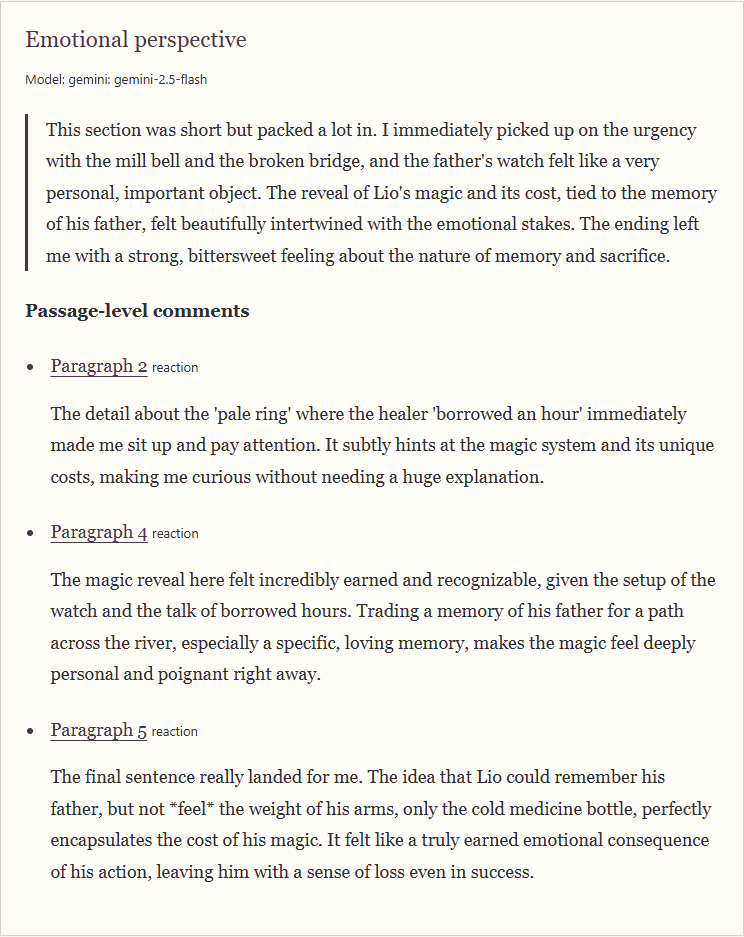
Give one reader Worldbuilding as a focus and another Plot logic. Include the scene establishing the rule as well as the scene using it. A single action paragraph cannot show whether the cost was established earlier. Use the focus note above as a starting point and check the quoted passages yourself.
Follow the question into a reading.
For the general reading brief and twelve reference questions, return to the main beta reader questionnaire.
These are original editorial questions and illustrative examples, not a survey or a promise of audience response.